

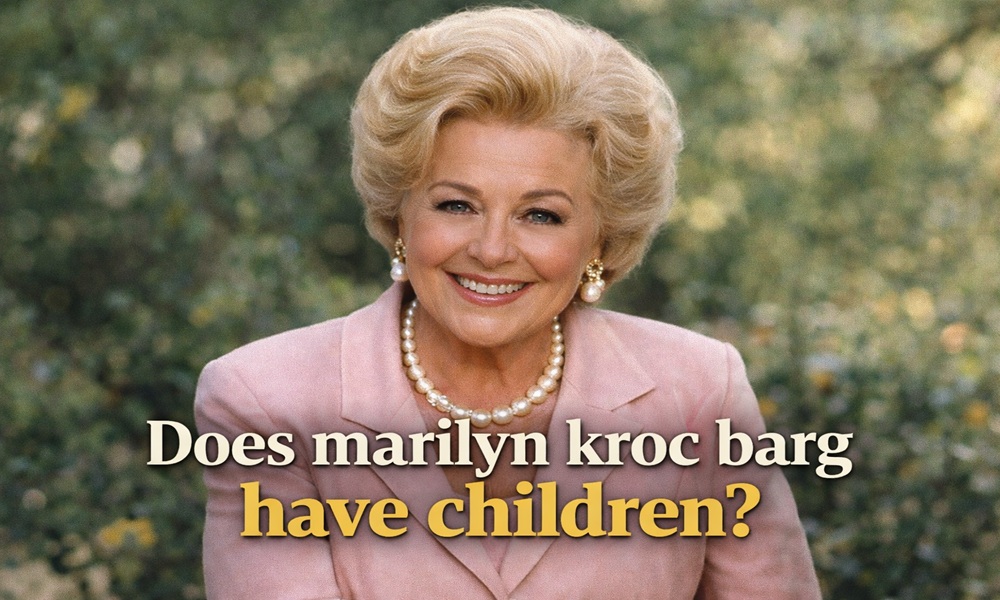
Marilyn Kroc Barg is a name that doesn’t often make headlines, yet her story is one of quiet courage, deep compassion, and lasting impact. As the only child of Ray Kroc — the visionary entrepreneur who turned McDonald’s into a global fast-food empire — Marilyn could have easily lived a life of luxury and spectacle. Instead, she chose privacy, purpose, and philanthropy. One of the most searched questions about her life is whether she had children of her own. This article explores that question in depth, while also tracing the full arc of her remarkable life.
Who Was Marilyn Kroc Barg?
Born Marilyn Janet Lynn Kroc on October 15, 1924, in Chicago, Illinois, she was the only child of Ray Kroc and his first wife, Ethel Janet Fleming. She grew up long before her father became famous, in a modest, hardworking household where values like discipline, empathy, and perseverance were instilled from an early age.
While Ray Kroc was busy traveling and building his career as a paper cup salesman and later a milkshake mixer salesman, Marilyn’s childhood was shaped by the energy of a father constantly striving for more — and a mother who provided stability and warmth at home.
When Ray Kroc finally acquired McDonald’s in 1961, Marilyn was already a grown adult. She witnessed her father’s transformation from a determined but modest salesman into one of America’s most celebrated businessmen. Despite the dramatic change in family fortunes, Marilyn remained grounded, preferring to live on her own terms rather than bask in reflected glory.
Quick Biography Overview
| Detail | Information |
|---|---|
| Full Name | Marilyn Janet Lynn Kroc Barg |
| Date of Birth | October 15, 1924 |
| Place of Birth | Chicago, Illinois, USA |
| Parents | Ray Kroc & Ethel Janet Fleming |
| Siblings | None (only child) |
| First Husband | Sylvester Nordly Nelson (m. 1949) |
| Second Husband | Walter James Barg (m. May 28, 1960) |
| Children | No confirmed children |
| Known For | Philanthropy; Ronald McDonald House Charities |
| Date of Death | September 11, 1973 |
| Place of Death | Arlington Heights, Illinois, USA |
| Cause of Death | Complications from diabetes |
| Resting Place | Memorial Park Cemetery, Skokie, Illinois |
Did Marilyn Kroc Barg Have Children?
This is the central question many people ask when researching her life — and the answer, according to all available sources, is clear: there are no confirmed public records indicating that Marilyn Kroc Barg had children from either of her two marriages.
Multiple genealogical records, obituaries, and biographical research consistently find no documented children in her name. Her obituary, published in the Chicago Tribune at the time of her death, makes no mention of children, listing only her husband and father as surviving family. It read simply: “BARG Lynn J. Barg, nee Kroc, of Arlington Heights, formerly of Evanston, loving wife of James W.; dear daughter of Raymond A. and the late Ethel J. Kroc.”
Why the Question Persists
The curiosity around whether Marilyn had children stems largely from the mystique surrounding the Kroc family legacy. Ray Kroc himself amassed a fortune exceeding $600 million by the time of his death in 1984, making questions about heirs and family continuation entirely understandable. However, Marilyn fiercely guarded her personal life. She was not a public figure, did not court media attention, and kept her family matters intensely private — a choice that has only deepened the mystery around her personal life.
It is also worth noting that Marilyn died young, at just 48 years old, after battling diabetes for several years. The combination of her health struggles, two marriages (the first of which ended in divorce), and a deeply private nature may have contributed to her choosing a life centered around charitable work rather than family expansion.
What She Chose Instead
Rather than channeling her energy into raising a family, Marilyn directed it toward causes that helped other people’s children. Her most significant philanthropic contribution — supporting the founding of Ronald McDonald House Charities (RMHC) — was specifically designed to help families with seriously ill children. In a profound sense, her legacy was built in service to the children of others.
Marilyn’s Two Marriages
First Marriage: Sylvester Nordly Nelson (1949)
Marilyn’s first husband was Sylvester Nordly Nelson, a World War II veteran. The couple married in 1949, but the relationship did not last. Details of the separation remain private, but they eventually divorced. No children were documented from this union.
Second Marriage: Walter James Barg (1960)
On May 28, 1960, Marilyn married Walter James Barg, an administrator who shared her passion for community service and philanthropy. This was the more enduring and stable chapter of her romantic life, lasting until her death in 1973. Together, the couple was involved in multiple charitable causes. Walter James Barg outlived his wife, passing away on June 17, 1984, and was buried at All Saints Catholic Cemetery and Mausoleum. No children were confirmed from this marriage either.
Family Tree: The Kroc-Barg Connection
Understanding Marilyn in the context of her family helps explain both her values and her choices.
| Relation | Name | Notable Information |
|---|---|---|
| Father | Raymond Albert Kroc (1902–1984) | Founder/builder of McDonald’s global empire |
| Mother | Ethel Janet Fleming (1901–1965) | Former actress; Ray Kroc’s first wife |
| First Husband | Sylvester Nordly Nelson | WWII veteran; marriage ended in divorce |
| Second Husband | Walter James Barg (1919–1984) | Administrator; philanthropic partner |
| Stepmother | Joan Kroc | Inherited Ray Kroc’s estate; major philanthropist |
| Children | None confirmed | No public or genealogical records exist |
It is notable that after Ray Kroc and Ethel Fleming divorced in 1961, Marilyn’s relationship with the Kroc family narrative became more complex. Her father went on to marry twice more, eventually wedding Joan Kroc, who became one of the most significant philanthropists in American history. Marilyn passed away more than a decade before her father, never witnessing the full flowering of the McDonald’s empire or the full charitable legacy her family would eventually build.
Marilyn’s Philanthropic Legacy: Mothering the World
Though she left no biological children behind, Marilyn Kroc Barg left a legacy that has touched millions of families worldwide. Her most enduring contribution was her instrumental role in the early development of Ronald McDonald House Charities (RMHC).
Ronald McDonald House Charities
RMHC was formally established in 1974 — just one year after Marilyn’s death — but its roots lay in the vision and work of people like Marilyn who believed that families of critically ill children needed more than just medical support. They needed a place to stay, a community to lean on, and someone who understood their pain.
Today, RMHC operates:
- Over 380 Ronald McDonald Houses in more than 60 countries
- Ronald McDonald Family Rooms inside hospitals worldwide
- Programs serving millions of families annually at little to no cost
Marilyn’s early advocacy helped plant the seeds for this sprawling network of compassion.
Other Causes She Supported
Marilyn’s philanthropic reach extended well beyond RMHC. Her personal battle with diabetes gave her a particular empathy for those suffering from chronic illness, and she channeled that empathy into action.
| Cause | Nature of Support |
|---|---|
| Ronald McDonald House Charities | Early founding advocate; vision for family housing near hospitals |
| Diabetes Research | Personal investment; she was a diabetes patient herself |
| Salvation Army | Supported holiday programs and kettle drives |
| Arts and Culture | Donations to arts programs and cultural institutions |
| Education Scholarships | Supported access to education for underserved communities |
| Political Fundraising | Hosted events for Republican leaders including Nixon and Reagan |
Personal Interests and Character
Beyond her charitable work, Marilyn was a woman of rich personal passions. She loved horses deeply — not as a casual hobby, but as a genuine life pursuit. She was an equestrian who dedicated significant time to breeding and competing. This love of horses spoke to her desire for simplicity, discipline, and a connection to the natural world.
She also had a strong appreciation for art and culture, supporting the arts financially and personally. Friends described her as warm, grounded, and deeply empathetic — someone who would rather listen than speak, and who found more meaning in giving than receiving.
Despite the extraordinary wealth and fame that surrounded her family name, Marilyn never adopted the trappings of celebrity. She was, in the truest sense, a private person who let her actions speak for her.
Health Struggles and Death
Marilyn’s life was cut tragically short. She had battled diabetes for many years, a disease that in the early 1970s was far harder to manage than it is today. The same illness that she personally funded research into ultimately claimed her life.
She passed away on September 11, 1973, in Arlington Heights, Illinois, at just 48 years old. Her funeral was private and modest — entirely in keeping with the woman she had always been. She was laid to rest at Memorial Park Cemetery in Skokie, Illinois.
At the time of her death, Marilyn’s estimated net worth was approximately $1 million — a figure that reflects not inherited passivity, but active, principle-driven financial management. She had chosen to use her resources for impact rather than accumulation.
Marilyn vs. Joan Kroc: Two Different Philanthropic Paths
It is useful to briefly compare Marilyn with her eventual stepmother, Joan Kroc, who inherited Ray Kroc’s estate after his death in 1984 and became one of the most celebrated philanthropists of the 20th century.
| Marilyn Kroc Barg | Joan Kroc | |
|---|---|---|
| Relationship to Ray | Biological daughter | Third wife |
| Philanthropic Style | Private, personal, community-focused | Large-scale, public, institutional |
| Key Contribution | Early RMHC advocate | $200M+ to NPR, Salvation Army, and more |
| Public Profile | Deliberately low | Moderately public |
| Legacy | Quiet but enduring | Highly visible |
Both women were shaped by their connection to the McDonald’s empire, yet took entirely different paths toward making the world better. Marilyn worked in the shadows; Joan stepped into the spotlight. Together, they represent the full breadth of what the Kroc family name came to mean beyond fast food.
Why Marilyn Kroc Barg’s Story Still Matters
Marilyn Kroc Barg’s life offers an important counternarrative to the cult of fame and visibility. She had every opportunity to be a public figure, to leverage her family name for social currency or personal gain. She chose not to.
Instead, she quietly built a life of meaning — supporting organizations that housed families in crisis, funding research into the disease that would ultimately take her life, and encouraging arts and education in her community. She had no children to carry on her name directly, but the institutions she helped nurture have, in a very real sense, become her children.
Her story is a reminder that legacy is not about lineage. It is about the lives you touch, the causes you champion, and the values you model. In that sense, Marilyn Kroc Barg left behind one of the most meaningful families of all — a global community of people whose lives were made better because she existed.
Frequently Asked Questions
Did Marilyn Kroc Barg have any children? No. There are no confirmed public or genealogical records showing that Marilyn Kroc Barg had children from either of her two marriages.
Who were Marilyn Kroc Barg’s husbands? Her first husband was Sylvester Nordly Nelson (married 1949, later divorced). Her second and final husband was Walter James Barg, whom she married on May 28, 1960.
Why did Marilyn Kroc Barg have no children? No official explanation exists. Her health challenges with diabetes, her two marriages (including one that ended in divorce), and her deeply private nature all likely contributed. She channeled much of her nurturing energy into philanthropy instead.
What is Marilyn Kroc Barg best known for? She is best known for her early advocacy and support for the Ronald McDonald House Charities, which provides housing and support for families of seriously ill children near hospitals.
When did Marilyn Kroc Barg die? She died on September 11, 1973, in Arlington Heights, Illinois, at the age of 48, from complications related to diabetes.
Is Marilyn Kroc Barg’s family still active in McDonald’s? Marilyn had no children to carry on her direct line. Her father Ray Kroc died in 1984. The Kroc family’s most public philanthropic legacy continues through institutions like RMHC, funded in part by the estate of Joan Kroc (Ray’s third wife).
