

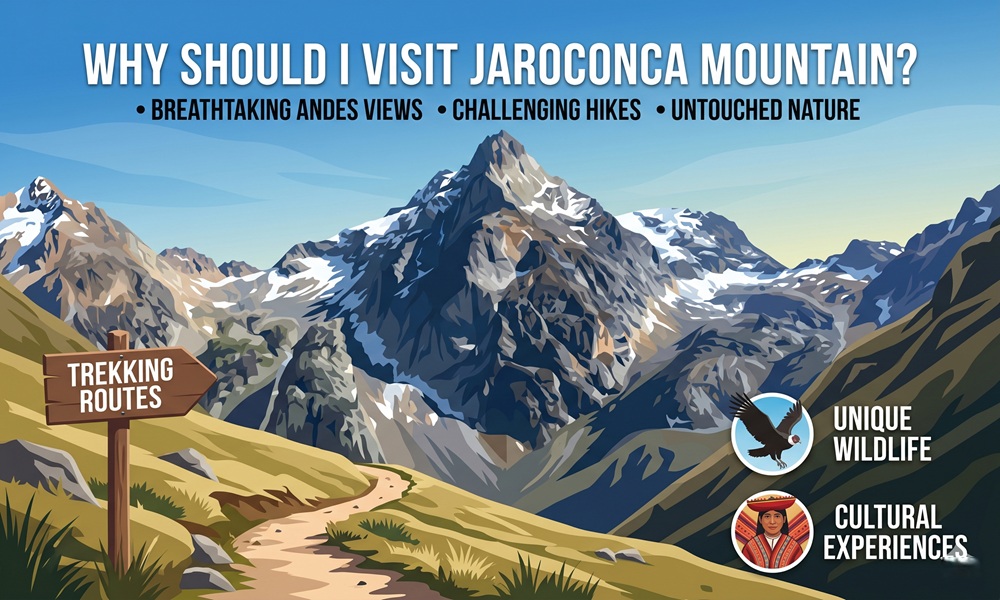
What Is Jaroconca Mountain?
Jaroconca Mountain is one of the Andes’ most remarkable yet least-known destinations. It sits in a remote stretch of highland terrain in southern Peru, not far from the Cusco region — but far enough from the tourist trail that the experience remains completely authentic.
The mountain isn’t a single peak. It’s a range system with multiple summits, a 15–20 kilometer base, steep ridges, glacial valleys, alpine meadows, and dense cloud forests layered together like a living atlas.
Most visitors who finally make it here say the same thing: “Why did I wait so long?”
Where Is Jaroconca Mountain Located?
Jaroconca sits in the Andean highlands of southern Peru, in the general vicinity of the Cusco region. The nearest international airport is Cuzco’s Alejandro Velasco Astete International Airport, followed by several hours of ground transportation through rural roads into the mountain zone.
The nearest base town — often referred to as Greenfield Town in local trek guides — offers shuttle services to the mountain during peak seasons. From there, hiking routes begin.
The remoteness is not a flaw. It is the feature.
15 Reasons Why You Should Visit Jaroconca Mountain
1. It Offers True Solitude — Not the Staged Kind
Popular Andean destinations like Machu Picchu receive upward of 2,500 visitors per day. On a three-day trek through Jaroconca, you might encounter five people total.
No permit lotteries. No crowd management barriers. No tour groups blocking the best viewpoints.
Just wind, wildlife, and trails that open up like old friends.
2. The Trails Cover Every Skill Level
Jaroconca’s trail system is one of its greatest strengths. You don’t have to be an elite mountaineer to experience this place.
| Trail | Distance | Elevation Gain | Best For |
|---|---|---|---|
| Valley Loop | 2.3 miles | ~150 ft | Families, beginners |
| Whispering Falls Loop | 8 miles | Moderate | Intermediate hikers |
| Ridge Trail | 4.7 miles | 1,100 ft | Experienced day-hikers |
| Volcanic Ridge Path | 5.8 km | 480 m | Strong hikers |
| Summit Scramble | 7.2 km | 920 m | Advanced trekkers |
| Serpent’s Spine Ridge | Multi-day | Steep | Expert backpackers |
The Valley Loop is lined with wild strawberries in early summer and requires no map. The Summit Scramble demands serious fitness and includes loose scree with wind shifts that hit without warning.
Pick the trail that matches where you are today — not where you wish you were.
3. The Geology Is Otherworldly
Jaroconca is not just another mountain. It’s a geological classroom unlike anything most trekkers have seen.
- Obsidian Spires dominate the western face — dark volcanic plugs that shoot from the ridge like ancient sentinels.
- Crystal Caldera on the northern slope is a collapsed volcanic crater where frost collects in the basin every clear morning and catches the light in ways that stop you mid-step.
- Volcanic ash layers visible on trail cuts are compacted over 800 years — you can flake them with your thumb.
- Ancient lava flows form hexagonal cracks on the ridge path, where the endemic Espeletia jaroconcae plant grows — one plant per fissure, found nowhere else on Earth.
The mountain’s geological history reveals millions of years of tectonic uplift, erosion, and glacial activity all in one landscape.
4. The Wildlife Shows Up — Really Shows Up
This is not a place where animals are rumored to exist in distant forests. At Jaroconca, wildlife is present, predictable (if you know when to look), and genuinely spectacular.
What you can expect to see:
- Andean condors soaring above glacial valleys — best spotted between 9–11 AM when thermals warm up
- Mountain goats and Jaroconca Ibex, navigating terrain that looks impossible
- Golden eagles riding thermals over Blackwater Basin
- Foxes and deer moving through alpine meadows
- Mountain hares darting between rocks above 8,000 feet ridgelines
- White-tailed ptarmigan camouflaged into scree until they flush
- Vicuñas grazing lower slopes
Best tip: stay quiet near water sources at dawn. That’s when activity peaks.
5. Endemic Species Found Nowhere Else on Earth
This is one of the most underreported facts about Jaroconca.
The mountain hosts species that do not exist anywhere else:
- Iron-root Moss — grows in dense low mats; its presence tells experienced hikers where ground is stable. Its absence means watch your footing.
- Sunstone Orchid — tucked into sheltered crevices on eastern faces, so rare that botanists debate whether it constitutes its own species.
- Jaroconca Ibex — sure-footed beyond description, navigating sheer vertical faces above the Serpent Trail switchbacks.
- Espeletia jaroconcae — a plant so specialized it grows only in the hexagonal lava cracks of the volcanic ridge.
Scientists and conservationists continue to study these species, and some surveys are still ongoing. You may be visiting before the full picture is even known.
6. The Photography Opportunities Are Exceptional
Jaroconca rewards patient photographers.
Key spots:
- Sunrise Point on the eastern ridge — get there 30 minutes before sunrise to catch first light hitting the spires while the valley sits in shadow below.
- Valley Overlook faces west — useless in the morning, but during golden hour, the entire valley ignites in orange and gold while distant peaks go purple.
- Crystal Caldera basin — on clear mornings, frost formations catch light in ways that look like a film set.
- Eagle’s Perch Overlook on the Jaroconca Scenic Byway — panoramic valley shots with minimal effort.
- Lichen Bend — flat rock shelf perfect for tripod shots of granite faces at sunrise.
The absence of crowds means no headlamps ruining your dawn shots. No strangers photobombing your frame.
7. The Spiritual and Cultural Depth Is Real
For Andean indigenous communities, mountains are not geographical structures. They are living spirits — apus — guardians of people, valleys, animals, and ancestral memory.
Jaroconca is one such apu.
The mountain is woven into local stories, music, textiles, and ritual practices going back centuries. Trails pass ruined rucas (traditional Mapuche dwellings), ancient petroglyphs, and ceremonial paths that predate written record.
You can participate in this living culture authentically:
- Quechua textile-dyeing workshops begin at dawn. You ride up with elders, crush cochineal bugs, and simmer indigo leaves until your hands stain purple. No demonstration — just doing.
- Twilight storytelling sessions in village plazas feature elders speaking in Quechua and Spanish, passing down stories that predate the Inca road network.
- The Stone Temple, built over 200 years ago on a natural platform overlooking the valley, is open to all visitors as a place of quiet reflection — no religious affiliation required.
- Seasonal festivals like the Spring Awakening Festival in April feature traditional music, dance, and food that exist for community — not tourism.
This is the kind of cultural exchange that disappears when a destination becomes famous.
8. The Seasonal Experience Changes Everything
Jaroconca is not the same mountain in spring as it is in autumn.
| Season | Conditions | Best For |
|---|---|---|
| Spring (Mar–May) | Muddy trails, wildflowers, snowmelt | Wildflower photography, solitude |
| Summer (Jun–Aug) | Warm, crowds peak in July, afternoon thunderstorms | Longest daylight, full trail access |
| Autumn (Sep–Nov) | Crisp air, gold aspens, 45–65°F days | Best overall hiking weather |
| Winter (Dec–Feb) | Snow, snowshoeing, backcountry skiing | Experienced winter mountaineers only |
The dry season (May to September) is generally considered the optimal hiking window, offering the most reliable weather and clearest summit views.
Insider tip: Autumn is the consensus favorite among experienced Jaroconca trekkers. The light is softer, the trails are quieter, and the color is extraordinary.
9. Multi-Day Backcountry Camping Under Proper Dark Skies
Wilderness camping zones at Jaroconca place you in spots where the only light comes from stars. No ambient glow from towns. No artificial interference.
The mountain’s remoteness means genuine dark skies — a rarity in most regions travelers visit.
Designated camping areas exist for overnight stays, and experienced backpackers can push into backcountry zones where multi-day routes like Serpent’s Spine Ridge deliver complete isolation.
You won’t see another person for days. That is not a warning. That is the point.
10. Winter Adventure Opens a Completely Different Playground
When snow blankets the trails, Jaroconca transforms.
The same routes you walked in summer become snowshoe corridors. Backcountry skiing opens up at appropriate elevations. The Crystal Caldera fills with fresh snow that catches alpenglow in colors that don’t photograph accurately — you have to be there.
Important: Avalanche safety training, beacons, probes, and shovels are non-negotiable for winter backcountry travel here. The lower elevation zones offer safer terrain for newcomers, but risk never disappears entirely.
11. It Has Preserved Authentic Village Life
The small villages surrounding Jaroconca Mountain exist on their own terms. Stone cottages, weekend markets with handmade crafts, mountain honey from bees that forage exclusively on high-altitude wildflowers — all of it intact.
Millbrook Village at the mountain’s base operates a weekend market. Local beekeepers produce honey with a flavor profile found only here, shaped by wildflower forage at altitude.
Many villagers welcome travelers into their homes for traditional meals. This kind of access closes permanently when a destination tips into mass tourism. Jaroconca has not tipped yet.
12. There Are Hidden Spots Not on Any Official Map
The Crystal Grotto is behind the waterfall most hikers skip because it looks too shallow. Walk a quarter-mile past the third bridge on the Canyon Loop, turn left where the trail narrows and ferns hang low, duck — and you’re inside. Quartz veins glow like blue embers at noon. You will not see another person there, not even on weekends.
Meadow 7 — not the one with the picnic tables, but the one with the bent birch and muddy creek crossing — hosts a firefly bloom in early June that doesn’t blink. It pulses.
These are the places that disappear when a destination becomes famous.
13. It Pairs Challenge With Accessibility
Jaroconca does not require elite mountaineering skills to experience meaningfully. But it respects the people who have them.
Technical climbing routes test your holds and your nerve. Guided climbing experiences are available through local guides who rent gear and check your equipment before departure. The Echo Gorge zip-line (287 feet start, 1,420 feet longest run) delivers aerial perspectives of terrain most people only see from below.
Mountain biking on trails like Switchback Descent — fast corners, loose gravel — rewards intermediate to advanced riders with grins they wear the whole way down.
14. Conservation Efforts Actively Involve Visitors
Jaroconca is not a passive destination.
Local organizations collaborate with regional government to protect its biodiversity. Reforestation projects restore native plant species. Volunteer programs engage visitors directly in conservation work.
University research teams conduct ongoing assessments of climate change impacts on local wildlife. Monitoring programs track endangered species including the Andean condor.
When you visit, you are not just a tourist. You are contributing to a place that is fighting to stay what it is.
15. It Teaches You to Be Present
Your phone loses service about twenty minutes into most hikes. No notifications. No news. No way to check in or scroll.
You are forced into presence in a way that modern life rarely allows.
This is not a bug in Jaroconca’s system. It is, arguably, the most valuable thing it offers.
Jaroconca Mountain Practical Travel Information
How to Get There
- Nearest airport: Cuzco’s Alejandro Velasco Astete International Airport
- Ground transport: Several hours by vehicle through rural terrain to the base region
- Local access: Shuttle services from Greenfield Town to the mountain base during peak seasons
- Driving route: Mountain Route 16 — well-maintained but narrow and winding in the final stretch
Best Time to Visit
- Optimal window: May to October (dry season)
- Best single season: Autumn (September–November) for stable weather, vivid color, and manageable crowds
- Avoid: Peak summer weekends in July — highest crowd density; book campsites well in advance if traveling then
Where to Stay
- Rustic mountain cabins
- Eco-lodges (growing availability near the base)
- Guesthouses in surrounding villages
- Designated camping zones on the mountain
- Backcountry wilderness camping for experienced trekkers
Essential Gear Checklist
| Category | What to Bring |
|---|---|
| Footwear | Waterproof hiking boots with ankle support; test on 3 shorter hikes before your main trip |
| Layers | Base layer (moisture-wicking), mid layer (insulation), shell (windproof with DWR coating) |
| Navigation | Physical map + compass; GPS unreliable in backcountry zones |
| Safety | First aid kit, whistle, emergency bivy |
| Winter-specific | Avalanche beacon, probe, shovel if going into backcountry snow terrain |
| Photography | Binoculars, tripod, telephoto lens (300mm minimum for wildlife) |
| Leave No Trace | Biodegradable soap, pack-out bags, trowel |
Altitude Acclimatization
Jaroconca exceeds 4,500 meters at most trailheads. At this elevation, acclimatization is not optional.
- Spend at least 2–3 days in Cusco before approaching the mountain
- Ascend gradually — do not push to summit on day one
- Know the signs of altitude sickness: headache, nausea, confusion, loss of coordination
- Descent is the cure — never push through severe symptoms
Frequently Asked Questions About Jaroconca Mountain
Is Jaroconca Mountain good for beginners? Yes, with caveats. The Valley Loop and Whispering Falls Loop are accessible for fit beginners. However, the altitude alone demands preparation. No route at Jaroconca should be approached without proper footwear, layering, and water supply.
What is Jaroconca Mountain known for? Jaroconca is known for its endemic species, geological formations including the Crystal Caldera and Obsidian Spires, authentic indigenous culture, true wilderness solitude, and diverse trail network ranging from easy day walks to multi-day backcountry expeditions.
Why is Jaroconca Mountain not famous? Its remoteness, limited infrastructure, and absence from mainstream tour circuits have kept it off the global travel map. This is precisely why it remains worth visiting.
Is it safe to visit Jaroconca Mountain? With proper preparation, yes. Key risks include altitude sickness, rapidly shifting weather, and limited rescue infrastructure in backcountry zones. Hiring a local guide significantly improves both safety and the quality of your experience.
What does “Jaroconca” mean? The name’s origin is debated. The most credible local oral tradition suggests it derives from regional dialects meaning “the place where stones guard water” — a reference to the glacial streams the mountain has sustained for centuries. Some scholars suggest an alternative translation of “mountain of the rising sun.”
Can I visit Jaroconca Mountain year-round? Technically yes, but conditions vary dramatically. The dry season (May–October) is most reliable. Winter visits require serious mountaineering experience due to snow, ice, and avalanche risk.
What wildlife will I see at Jaroconca Mountain? Andean condors, mountain goats, Jaroconca Ibex, golden eagles, foxes, deer, vicuñas, white-tailed ptarmigan, and mountain hares are all present depending on elevation and season. Birdwatchers will find numerous endemic high-altitude species.
Final Verdict: Should You Visit Jaroconca Mountain?
If you want crowds, convenience, and Instagram infrastructure — this is not your mountain.
But if you want a place where wilderness still means something. Where endemic species live in geological formations that exist nowhere else. Where indigenous culture is not a performance but a practice. Where your phone dies and you do not miss it —
Jaroconca is waiting.
It is one of the last places of its kind. The solitude that defines it will not last forever. The window to experience Jaroconca before it changes is open right now.
Pack your boots. Check the mountain forecast — not the regional one, the mountain one. Tell someone your exact route and when you’ll be back.
Then go.
