

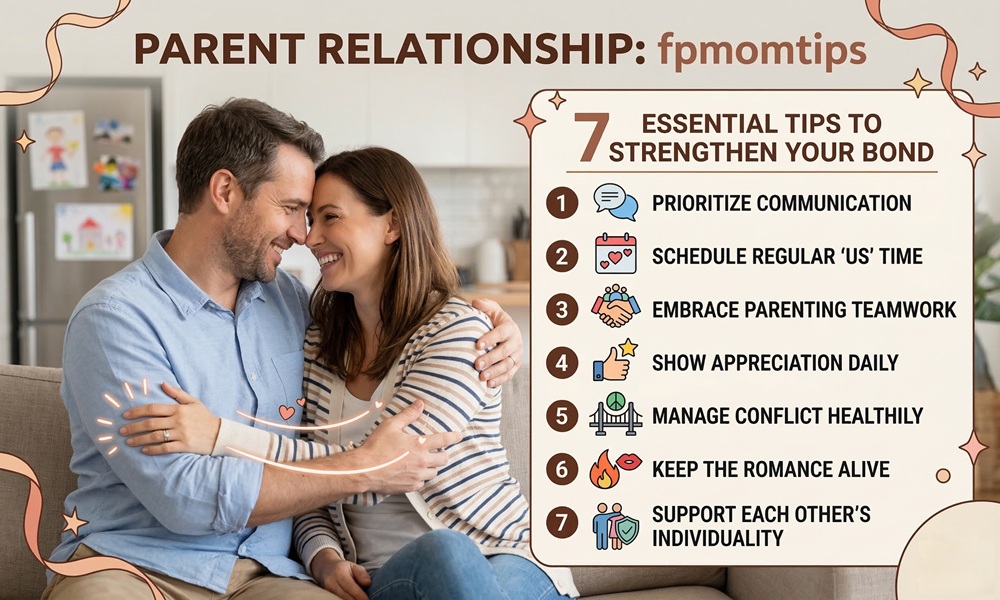
A strong parent relationship is more than just shared responsibility — it is the emotional infrastructure of a family. When parents, whether in a partnership or co-parenting arrangement, maintain mutual respect and open communication, children grow up feeling genuinely safe and loved. This is precisely what parent relationship FPMomTips is all about: actionable, realistic, and compassionate guidance drawn from modern family psychology and real-world parenting experience.
FPMomTips, which stands for Family, Parenting, Mindset, Organization, and Mindfulness, is a growing philosophy rooted in the idea that connection should always come before correction. Whether you are a first-time parent, co-parenting across two households, or navigating the teenage years, the principles remain universal: show up, listen deeply, and invest in the relationship — not just the rules.
“Children don’t just remember what parents did for them — they remember how parents made them feel. Feeling heard, valued, and supported forms the emotional bedrock of lifelong confidence.”
Why the Parent Relationship Is the Foundation of Family Health
Research in family psychology consistently shows that the quality of the parent-child relationship influences academic performance, emotional regulation, social development, and even adult mental health. Children raised in homes where parents model healthy communication and mutual respect develop higher emotional intelligence (EQ) and demonstrate fewer behavioral challenges.
The parent relationship also shapes how children understand love and partnership. When they witness their parents — or co-parents — resolving conflict calmly, expressing appreciation, and working as a team, they internalize those patterns and replicate them in their own future relationships.
| Relationship Quality | Impact on Child | Long-Term Outcome |
|---|---|---|
| Secure & Supportive | High self-esteem, open communication | Resilient, emotionally healthy adults |
| Inconsistent | Anxiety, difficulty trusting others | Struggles with stable relationships |
| High-Conflict | Stress, avoidance, people-pleasing | Higher risk of depression in adulthood |
| Distant or Disconnected | Low emotional vocabulary, withdrawal | Difficulty with intimacy and vulnerability |
| Warm but Boundaried | Confidence, healthy peer relationships | Strong values and self-discipline |
Core Parent Relationship FPMomTips That Actually Work
The following strategies are drawn from both family psychology research and the lived experiences of modern parents. They are not grand gestures — they are daily habits that compound over time into something profound.
1. Practice Active Listening
Put devices away, make eye contact, and reflect back what your child says before responding. This alone dramatically increases trust and makes children feel genuinely seen.
2. Prioritize Daily Connection
Even 10–15 minutes of uninterrupted, one-on-one time daily creates a sense of emotional security that lasts all day. The activity matters less than the undivided attention.
3. Validate Before You Correct
Acknowledge your child’s feelings before addressing behavior. “I see you’re frustrated” opens doors that “stop that” slams shut. Validation is not agreement — it is acknowledgment.
4. Model the Relationship You Want
Children learn respect, empathy, and communication by watching how you treat your co-parent or partner — not by being told to behave. Your relationship is their classroom.
5. Repair After Conflict
Rupture and repair is natural in every relationship. What matters most is how quickly and genuinely you reconnect after an argument or misunderstanding. A simple “I’m sorry I raised my voice” is enormously powerful.
6. Speak Appreciation Often
Simple words — “I’m proud of you,” “thank you for telling me that” — build emotional reserves children draw from during hard times. Praise effort and emotional courage, not just achievement.
Communication: The Heartbeat of Every Strong Parent Relationship
If there is one thread that runs through every aspect of FPMomTips guidance, it is this: communication is not just talking — it is the art of making another person feel understood. This applies to how parents speak to each other and how they speak to their children.
Building a Communication-First Home
Many families fall into patterns of reactive communication — only speaking up when something goes wrong. A communication-first home builds regular, low-stakes conversations into everyday life so that talking feels natural and safe before a crisis demands it.
- Morning check-ins — A brief “how are you feeling today?” at breakfast sets the tone for openness throughout the day.
- Tech-free mealtimes — Removing screens at the dinner table has been shown to significantly increase family conversation quality.
- Weekly family huddles — 15–20 minutes to discuss wins, challenges, and upcoming plans as a unit.
- Emotion labeling — Teach children to name their feelings — joy, frustration, nervousness — rather than acting them out.
- Conflict resolution rituals — Agree as a family that disagreements are addressed calmly, privately, and without blame.
Between Co-Parents: Unity Without Perfection
One of the most powerful things two parents can offer their child is the visible sense that they are on the same team. This does not mean agreeing on everything — it means handling disagreements away from the children, presenting decisions jointly, and never using a child as a messenger or emotional support during adult conflict.
⚠️ Common Communication Mistakes to Avoid: Dismissing a child’s feelings (“You’re fine, stop crying”), arguing in front of children, using ultimatums (“Because I said so”), and inconsistent responses to the same behavior all erode trust over time — even when parents have the best intentions.
Parent Relationship FPMomTips at Every Stage of Childhood
The approach to parent relationships must evolve as children grow. What works for a toddler will not work for a teenager. Here is a stage-by-stage breakdown of how to keep the connection strong:
👶 Infants & Toddlers (0–3 years)
Physical closeness, responsive care, and predictable routines form the foundation of secure attachment. Respond to needs promptly — you cannot spoil a baby with attention. Consistency in your response builds neurological pathways for trust.
🧒 Early Childhood (4–7 years)
Play is the primary language of connection. Engage in imaginative, child-led play daily. Explain rules with brief, calm reasoning rather than commands. This is the stage where emotional vocabulary begins forming in earnest.
🎒 Middle Childhood (8–12 years)
Peer influence grows significantly, so staying relevant requires genuine curiosity about your child’s world. Ask about their interests, not just their homework. Attend their events, know their friends, and withhold judgment to keep lines of communication open.
🧑 Teenagers (13–18 years)
Autonomy becomes the central developmental need. Shift your role from director to consultant. Listen more than you advise. Stay connected through shared activities and non-judgmental conversations — the goal is to remain their safe harbour even as they push boundaries.
Emotional Intelligence: The Hidden Superpower of FPMomTips
One of the most consistent themes in FPMomTips guidance is the development of emotional intelligence — in both parents and children. EQ is increasingly recognized as a stronger predictor of life success than IQ alone. Children with high emotional intelligence handle peer pressure more effectively, perform better academically, and build healthier relationships throughout life.
How to Build Emotional Intelligence at Home
- Model calm emotional regulation — when you’re frustrated, narrate it: “I’m feeling overwhelmed right now, I’m going to take a breath.”
- Never shame or dismiss emotions, even difficult ones like anger or jealousy.
- Create a feelings vocabulary with young children using books, charts, or conversations.
- Encourage empathy by asking, “How do you think that made them feel?”
- Celebrate emotional courage — praising a child for expressing vulnerability is just as important as praising academic achievement.
Relationship Hacks: Quick FPMomTips for Busy Families
Modern parents are stretched thin. Between school runs, work deadlines, household management, and personal wellbeing, finding time to nurture family relationships can feel impossible. Therefore relationship advice fpmomhacks are designed for real life — low effort, high impact.
| Hack | Time Required | Impact |
|---|---|---|
| 2-minute bedtime check-in | 2 min/night | Builds emotional intimacy, surfaces hidden worries |
| Shared family calendar | Set up once | Reduces scheduling conflict, builds teamwork |
| Daily gratitude share | 5 min/day | Shifts family culture toward positivity |
| Tech-free Sunday morning | 2 hrs/week | Deep reconnection, creates cherished memories |
| Prepare school bags the night before | 10 min/night | Reduces morning stress and conflict |
| Monthly “yes day” for kids | 1 day/month | Strengthens trust and child-led bonding |
Setting Boundaries With Love: The Balance FPMomTips Champions
Healthy parent relationships are not permissive — they are warm and structured. Boundaries are not the opposite of love; they are one of the clearest expressions of it. Children raised with firm but loving boundaries develop a stronger sense of self, better impulse control, and deeper respect for others.
The FPMomTips approach to boundaries is built on three principles: clarity (children know exactly what is expected), consistency (rules are applied predictably), and compassion (corrections are delivered without shame or humiliation). This triad builds an environment where children feel genuinely safe to grow, make mistakes, and try again.
Signs of a Healthy, Boundaried Parent Relationship
- ✓ Children know what the rules are and why they exist
- ✓ Consequences are predictable, proportional, and followed through
- ✓ Children can disagree respectfully without fear of punishment
- ✓ Parents distinguish between the child and the behavior (“I love you; that behavior is not okay”)
- ✓ Repair conversations happen after conflict
- ✓ Both parents are aligned on core rules, even if parenting styles differ slightly
Self-Care as a Relationship Strategy
One of the most overlooked FPMomTips is this: you cannot pour from an empty cup. A parent who is chronically exhausted, emotionally depleted, or overwhelmed will struggle to be present, patient, and emotionally available — no matter how much they love their child. Self-care is not indulgence; it is maintenance for the most important relationship tool you have: yourself.
This includes protecting time for adult friendships, seeking support when parenting feels overwhelming, maintaining basic physical health, and — crucially — treating yourself with the same compassion you extend to your children. Strong family bonds begin with well-nurtured individuals at the centre of them.
Final Thoughts
Parenting is not about perfection — it is about presence, progress, and the quiet courage to keep showing up. The principles behind parent relationship FPMomTips offer a practical, human-centered roadmap: listen more than you lecture, connect before you correct, repair what breaks, and model the love you want your children to carry into their own lives.
The small moments — a bedtime conversation, a shared meal, a genuine apology — are not small at all. They are the foundation of everything.
